 Wind Family
Every guide to kitesurfing in Watamu tells you the same two things: the wind is reliable and the water is warm. Both are true. But we live here, teach here, and grew up riding here, so this guide goes further. It is everything we would tell a friend who just landed, in the order they would need it.
The spot
Watamu sits on Kenya's north coast, about two hours north of Mombasa, on the edge of a marine national park. The town faces a chain of bays and white-sand beaches, and in front of them lies the thing that makes this place special: a wide, shallow lagoon protected by a coral reef.
The reef takes the ocean swell, so inside the lagoon the water stays smooth even when the wind is pumping. At the right tide you can stand in chest-deep water hundreds of metres from shore. That combination, steady wind over flat, shallow, warm water, is what every kite instructor in the world wishes they had. Here it is just Tuesday.
Beginners get a forgiving classroom with sand underfoot. Freestylers get butter-flat sections to throw tricks on. Wave riders get real ocean swell breaking on the reef when the strong season arrives. Few spots cover all three.
Wind: the two seasons
The Kenyan coast runs on two trade winds, and the locals call them by their Swahili names.
Kusi (roughly June to September). The southern trade wind, and the strong season. It blows side-onshore day after day, often 25 knots and above, and it is the most consistent wind of the year. If you want maximum time on the water and do not mind a bit of chop building through the afternoon, this is your season. Bring your smaller kites.
Kaskazi (roughly December to April). The northeast monsoon: lighter, warmer, and steadier through the day, typically in the high teens to mid twenties of knots, often starting earlier in the morning than kusi does. It is the friendlier season for learning and for big-kite freeriding, and it coincides with the Kenyan coast at its sunniest.
Between the seasons, the wind takes a break and so does everyone else. May and October to November are quiet months: good for diving, snorkeling and slow beach days, not for planning a kite trip.
Whichever season you come in, the water stays warm enough for boardshorts all year. Most riders never put on more than a lycra top, and that is mainly for the sun.
Tides change everything
If the wind sets the rhythm of your week here, the tide sets the rhythm of your day. The tidal range in Watamu is measured in metres, and the lagoon transforms with it: a wide open playground at high water becomes a maze of sandbars and shallow coral a few hours later.
This is not a problem, it is the schedule. Locals plan sessions around the tide as naturally as around the wind, and the flat sections behind the sandbars at a falling tide are some of the best water you will ever ride. But it does mean two things: check a tide table before you pump up, and on your first days, ask someone who knows the spot. Which brings us to the schools.
Learning here, and who to learn with
Watamu's schools are small, lagoon-front operations where the instructor who briefs you on day one is the same person cheering when you ride away upwind on day five. The three schools in the Wind Family network all teach on the lagoon and all work the same way: one-on-one or small-group lessons, equipment included, sessions timed to wind and tide.
Simba Kite School sits right on the lagoon and teaches everyone from first-timers to visiting riders chasing their next move. Local Kite School is exactly what its name says, a school by and for the coast it stands on, the kind of place where every student is known by name. JC Kite School covers the full arc from taster sessions to progression coaching for riders working on tricks, transitions and wave riding.
We will not pretend to be neutral: these schools are the reason this website exists. They are the members of Wind Family, which means every one of them also teaches local kids from Watamu's children's homes for free, on the same water, with the same instructors you will have. Book a lesson with any of them and you are, indirectly, helping keep that program on the water.
If you already ride independently, all three schools rent kites, boards and harnesses to certified riders, and offer storage if you are staying a while.
For experienced riders
A few notes the brochures skip:
- Stay inside the reef unless you have a boat. The lagoon is generous, but beyond the reef line is open Indian Ocean, and the wind and current want to take you there. Wave sessions on the reef are excellent in kusi, with local knowledge or a boat watching you.
- Downwinders are possible and beautiful, along miles of beaches and bays. Arrange the logistics with one of the schools rather than improvising.
- Watch the low-tide coral. Fins and coral heads find each other. Ride the sand-bottomed sections at low water, or wait for the push.
- The beach is shared. Glass-bottom boats, swimmers near the hotels in high season, mooring lines. Launch and land away from the crowds and give everything a kite line of room.
For the full honest list, including the reef map we made ourselves:
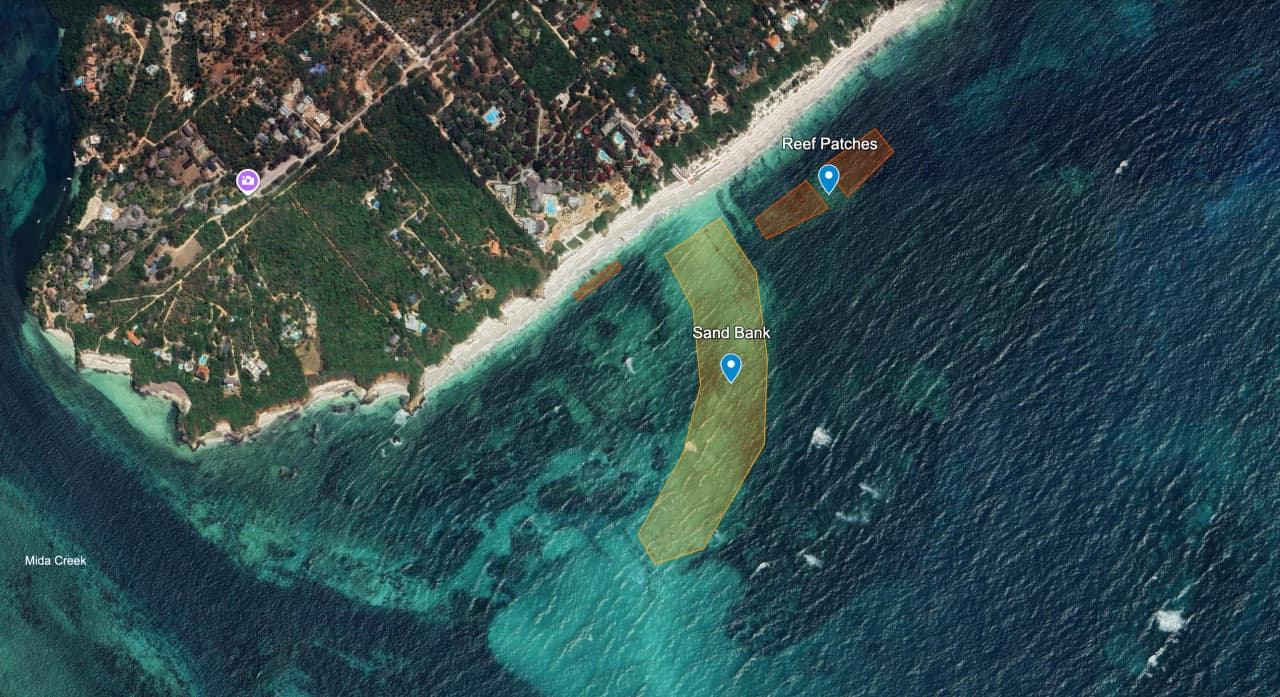 Kitesurfing hazards in Watamu
Getting here
The closest airstrip is Malindi (MYD), about half an hour's drive north of Watamu, with daily connections from Nairobi. The bigger gateway is Mombasa (MBA), roughly a two-hour drive south. Any hotel or school can arrange a transfer from either; ask when you book your first lesson and it usually sorts itself out.
Kite gear flies the same way it does everywhere: as sports baggage, declared in advance. If you would rather travel light, rental gear here is modern and well maintained, and for a first trip we would honestly suggest coming with nothing but a harness if you own one you love.
Watamu itself is a small town. Accommodation runs from backpacker rooms to beach villas, most of it within a short tuk-tuk ride of the kite beach. Stay close to the water if you can: sessions here are decided by a look at the palm trees, and the riders who score the best wind are the ones who can be rigged in ten minutes.
The marine park
The reef and lagoon are part of the Watamu Marine National Park and Reserve, one of the oldest marine protected areas in Africa. It is the reason the water here still looks the way it does. The practical version: do not stand on or anchor to coral, take nothing, leave nothing, and note that single-use plastics are banned in Kenya's protected areas. Boat operators and schools know the zoning; when in doubt, ask.
It is a privilege to ride inside a protected area. Treat it like one and it stays open to everyone.
What to pack
- Kites for both ends of your season: bigger for kaskazi, smaller for kusi
- A lycra top or thin wetsuit top, for sun more than cold
- Reef-safe sunscreen, and more of it than you think
- Booties if you have sensitive feet; the sandbars are kind but the coral is not
- A tide app, or the humility to ask the beach crew
- Cash in Kenyan shillings for tuk-tuks and beach lunches; M-Pesa and cards cover most of the rest
Why ride here, of all places
Plenty of spots have wind and flat water. What Watamu has is a community that treats the lagoon as something to pass on. The schools here came together as Wind Family to share what they have, instructors, kites, water time, with local kids who would otherwise watch from the beach. Some of those kids are now the confident young riders you will share the lagoon with.
So come for the wind. It will not disappoint. But do not be surprised if what you remember is the place itself: the tide going out over the sandbars, the boats coming home past the reef, and a kid on a borrowed board riding upwind for the first time while the whole beach cheers.
If that resonates, there are easy ways to get involved, whether you ride, teach, or just travel with good gear you no longer use.
Karibu Watamu. See you on the water.